Koi Koi Seven Posted by Hello

EREMENTAR GERAD
 Posted by Hello

Speed Grapher Posted by Hello

The Strawberry Marshmellow Posted by Hello

Basilisk Posted by Hello

RECIPE FOR SUCCESS:Soup masters

asahi.com : English
RECIPE FOR SUCCESS:Soup masters
By SAYAKA YAKUSHIJI:Contributing Writer
Masahiko Yamada samples his latest experiment at Nissin Food Products Co. central research center in Kusatsu, Shiga Prefecture.

As instant ramen spreads around the globe, researchers in Japan continue to pursue the perfect taste. `You are not born with taste buds. It's something you build up.' MASAHIKO YAMADA Researcher of Nissin Food Products Co.

This is the fourth installment in a series on Japanese inventions and what they offer to the world in 2005.

KUSATSU, Shiga Prefecture-Inside his spotless laboratory, Masahiko Yamada carefully examines the results of his experiment. The concoction he has created could change the lives of millions around the nation.

Yamada, wearing a light green uniform, samples a glass of clear liquid scooped from the large metal pot containing two large chickens, onions, carrots, scallions, shiitake mushrooms and seaweed.

He pauses before evaluating the mixture.

``The soup's got the sweetness of the chicken,'' he says. ``They are broiler chickens, but they give their own good flavor.''

Yamada's job is to find the ultimate soup. After all, he was given the title of ``soup master'' from his company two years ago.

The title is warranted, according to those who know the 57-year-old researcher of Nissin Food Products Co. They consider Yamada a ``living god'' of instant ramen noodles.

The world's first instant noodle was created by Momofuku Ando, the founder of Nissin, in 1958.

In the 45 years after the invention, production of instant noodles expanded by 422 times and became a common part of the Japanese diet. On average, a Japanese ate 42.7 servings of instant noodles in 2003.

Easy-to-prepare ramen has also won international recognition, influencing global culinary lifestyles. World demand for instant noodles topped 65.25 billion servings in 2003, according to a survey by the International Ramen Manufacturers Association.

Researchers like Yamada are the keys in the development of the noodle products. At Nissin's central research center here, 17 soup experts toil day and night in search of new flavors.

In his more than three decades of working at the nation's leading maker of instant noodles, Yamada has been involved in creating soup seasonings for more than 100 products, including such long-selling hits as ``Demae Iccho'' and ``U.F.O.''

One of his recent achievements is ``Gyoretsu no Dekiru Mise no Ramen,'' which means ramen noodles of a shop crowded with fans.

It's not just broilers Yamada has tried out to find the perfect broth. He has tested sea bream, dried squid and soft-shelled turtles; anything that catches his eye can be a potential ingredient.

``Recently, I had a chance to go to a market in Kyoto. They had pretty good local vegetables,'' he says.

But being a soup meister is not easy. Whenever he takes a business trip, he feels obliged to check out local ramen shops, often six to seven a day. To figure out the secret of success, Yamada peeps into kitchens or

chats with the chef.

The trips can sometimes be ``just hellish.''

``Hokkaido is pretty tough. Their noodles are wide and hard. Once, I had to run to a drug store and get a laxative in between ramen shops,'' he says. ``Kyushu is easier. You can go for two or three rounds. Drinking alcohol helps, you know.''

The direct experiences are essential for Yamada's job.

``There are cookbooks written by famous cooks. But you can't recreate the same flavor by just looking at the recipe. What's really important is not in the book,'' he says.

And the competition in Japan is always close behind.

In 2003, at least 889 brands of instant noodles were marketed nationwide. With the rapid cycle of repackaging traditional brands and creating new products, about 200 flavors are developed annually by Nissin.

Coming up with the right seasoning can take several months. To prepare for the endless sampling session-researchers try out 30 to 40 soups (including noodles) in just one day-Yamada stays in shape. He recently completed a two-day marathon covering 80 kilometers.

``You are not born with taste buds. It's something you build up,'' says Yamada, who has visited hundreds of ramen shops around the nation.

Ramen, consisting of flour noodles kneaded with kansui water and served in hot soup, originated in China. Japanese packaging technology spread the ramen culture around the world.

``Chicken Ramen,'' the world's first instant noodle, was born after Nissin founder Ando witnessed people lining up at ramen stalls in war-torn Osaka. He saw a business opportunity in creating preservable noodles.

Fried noodles mixed with seasoning came handy in Japan during times of economic expansion. Busy workers wanted something quick to keep their stomachs full.

The Japanese creation proved useful in other countries, expanding to regions from Russia to Africa where ramen was not exactly part of the dietary tradition.

Nissin has also grown. It now operates 25 overseas factories in eight countries, including the United States, the Netherlands, Brazil, Indonesia and India. Seeing potential demand from the Middle East to Eastern Europe, Nissin predicts worldwide demand of instant noodles will reach 100 billion servings by 2010.

Like many other companies in the manufacturing industry, Nissin sees enormous potential in China. In 2003, 27.7 billion servings of instant noodles were consumed in China, accounting for more than 40 percent of world consumption.

Ironically, the inventor of instant noodles is struggling at the original home of ramen.

The majority of the Chinese market is currently occupied by Taiwanese and Chinese firms that can take advantage of low prices and distribution channels.

To gain a foothold, Nissin began producing its brands in the three coastal areas of Guangdong province, Shanghai and Beijing in the late 1990s. Furthermore, the company recently set up a research center in China, dispatching Japanese instant-noodle researchers to analyze and explore the needs of the local market.

Localizing flavors is essential for acceptance of the product. Nissin had earlier opened similar research centers in the United States and Europe to pinpoint the tastes of consumers there.

``For example, instead of soy sauce or miso flavor, chicken, beef, pork and seafood are the main soup seasonings in China,'' says Shinji Hiratani, manager of the international division at Nissin in charge of overseeing the Chinese region. ``Even the preferred taste of seafood is different according to the regions.''

While his colleagues are trying to figure out the ultimate soup abroad, Yamada waits patiently in front of the large pot in his lab in Kusatsu. The chickens have been cooking over a low flame for more than three hours, but Yamada says four more hours are needed before the end result is complete.

Yamada's patience and enthusiasm come from his ``belief'' in instant noodles, a dish he has adored from his college days in the 1960s. ``What's tasty is what's tasty,'' Yamada says. ``It's just that the flavor has not been in people's dietary habits.''(IHT/Asahi: January 5,2005)(IHT/Asahi: January 5,2005)

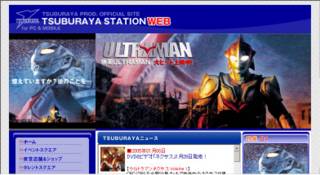
Ultraman Nexus on the web Posted by Hello

Tsuburaya Station Web. Production work on the new ULTRAMAN NEXUS on display.
 Posted by Hello

Best Anime for 2004

What was the best anime of 2004? It depends on who you ask. Tell us who the winners and losers are:

Manga animates new millennium

The Japan Times Online

Manga animates new millennium
Underground art revealed

By KEN KAWASHIMA
Special to The Japan Times

Manga took a giant leap into its future on New Year's Day 1963, when space-age cartoon images from Osamu Tezuka's famed comic book "Tetsuwa Atomu (Astro Boy)" came to life in Japan's first original animated TV series. This was the birth of anime, which has now mushroomed into a multi-billion-dollar global industry.

Cover artwork for Kagayake Daitoua-Kyoueiken by Shintaro Kago; gouache and ink on paper

A year later, however, the same industry coughed up Garo, a 180 yen underground manga magazine, which, in many ways represented everything that Tezuka's loveable "Astro Boy" was not, giving a voice to a generation of largely unknown underground manga artists and writers whose works were often laced with dark, satirical narratives and weird, surrealistic imagery.

When Missouri-born artist and curator Tim Evans first flipped through the dog-eared pages of an old Garo magazine in 1992 during his college years in California, not only was he introduced to the wilder side of Japanese manga culture, but also to a fresh and dynamic medium for visual expression that would profoundly alter his career.

"I always loved Garo because of its ardent commitment to political and aesthetic radicalism, and also because it was renowned for publishing the works of young and emerging cartoonists," 34-year-old Evans says in an e-mail interview from the United States. "In a sense, Garo is a kind of a blueprint for my own artistic endeavors."

Evans has now brought together selected works from more than 30 artists, mostly from Japan and the U.S., in an exhibition titled "Psionic Distortion" running Nov. 11-30 at the SuperDeluxe event space in Roppongi, Tokyo.

The multi-media exhibition -- which incorporates paintings, sculptures and segments from various artists' comic books as well as live music events -- features both the works of cutting-edge Japanese comics artists like Shintaro Kago and Akino Kondoh and artwork by manga-inspired artists from the States like Kenjji and Toby Barnes.

Another highlight will be the numerous video installations produced by popular visual artist Keiji Ito, which will be screened throughout the mostly admission-free 20-day exhibition. Ito, who recently created the poster art for "Expo 2005 Aichi, Japan," will also lend his talents as a guest DJ for the opening party (which is open to all) on Nov. 10, and participate in a panel discussion with fellow artists the following evening (for both of which a small admission fee will be charged).

"Manga has served as a catalyst for self-expression and a powerful springboard in dynamic nihilism in the 21st century, in much the same way that jazz, blues and hip-hop grew out of very specific historical situations and consequently took on vibrant new forms in various parts of the world," says Evans. "Psionic Distortion" aims to demonstrate how Japanese popular culture has been dispersed and transformed throughout the West (particularly in America), and is currently influencing a younger generation of artists.

If "Pikachu" -- from the anime megahit "Pokemon" -- is the new millennium's answer to "Astro Boy," then the eclectic circus of strange and subversive artifacts on display in "Psionic Distortion" is likewise Garo-esque in its aims.

Manga artist Shintaro Kago, who will contribute several illustrations from his manga book covers, certainly knows how to test the limits of what is art (and good taste) with his oftentimes sexually and politically charged manga comics. In one strikingly colorful image, uniformed Japanese schoolgirls wave the Hinomaru flag as Zero fighter planes circle the bright blue sky. One girl has an eyeball falling out of its socket from a gunshot blast to her head. Another hairless girl stands beside a wild-eyed and bloodied schoolmate in a state of purplish radioactive decomposition.

Although perhaps not as bleak as his Japanese counterpart, comic-book sequences taken from Detroit-based Afro-American manga artist Kenjji are no less political in their vision. Kenjji has created his own self-styled brand of kuroi-manga (black comics), and is particularly known for his groundbreaking concoction "Witch Doctor: Protector of the People." Kenjji's protagonist, Jovan, is a sharp-suited black superhero with D'Angelo-style cornrowed hair, who not only fights Zombies and racist stereotypes, but is on a spiritual mission to unearth the hidden riches of Voodoo culture and ancient African history.

"[Japanese] manga culture has shown to my audience that comics, cartoons and illustrative art can deal with a broad range of issues, not just typical superheroes," says Kenjji, whose own initiation to Japanese comics was Katsuhiro Otomo's post-apocalyptic thriller "Akira" in the early '90s. "In America we still struggle to bring out different material from the mainstream, but typically the trite material is always more popular," he says. Works by American painter Toby Barnes project a heavier influence from late '80s and '90s Japanese robot animation classics like "Gundam" and "Evangelion."

"Being Asian-American," says New York-based Barnes, "my family would travel east every several years on vacation and that's when I would bring back toys and comics. Because I didn't have much anime or manga stuff to play with or look at while at home in the U.S., I would have to find a creative way to fill in this void."

As a child, he copied images from old Japanese comic books and creating his own storyboards and scenarios. This childhood escapism fueled his creative drive years later when, as a frustrated art student, he decided to unlearn most of the classical drawing techniques he had absorbed in school. Instead, he began seriously painting the robot doodles that had turned him on in his youth.

However, the cross-cultural exchange at the heart of "Psionic Distortion" also works both ways. Tokyo-born graphic designer and collage artist Keiji Ito, known for his acid-inspired collage art of psychedelic flower gardens and motorways, says he has received no inspiration at all from the manga culture of his own country. The artist, who instead namedrops Americans like the film director Richard Fleischer and cartoonist Robert Crumb as his artistic influences, says he feels quite distanced from the whole global anime and manga boom.

"On the other hand, those glorious American cartoons and animated films I watched on TV as a child have had an enormous impact on me," says Ito. "I think it's that almost ecstatic sense of happiness and optimism I witnessed on the TV screen in my childhood that really messed up my brain today."

For exhibition-goers not yet exposed to the darker side of Japanese manga, though, "Psionic Distortion" may also prove to be a heavy visual experience that's both disturbing and enlightening.

"The term 'Psionic' refers to the superhuman powers many anime and manga characters possess, like the power exhibited by a monk or yoga master who is deep into his/her practice," Evans explains when asked about the show's title. "They sometimes claim that their third eye has awakened, and that quasi-mystical experience is what 'Psionic' is all about -- a deep and profound insight into the human condition."

Don't say you haven't been warned.

"Psionic Distortion" runs Nov. 10-30 at SuperDeluxe (tel: [03] 5412-0515), a 5-minute walk from Roppongi Station on the Hibiya Line. For more information on the artists and related events, call SuperDeluxe or visit www.super-deluxe.com

The Japan Times: Nov. 10, 2004
(C) All rights reserved